Technology, Youth & The Influences They HoldBrandon Griggs
In 2011 the young generations of Tunisia, Egypt and Libya have used their passions in conjunction with the technology at their disposal, to craft a better future with varied results. The youths of these nations were sick and tired of how things worked. Corruption, bribery and money embezzlement were common themes. In addition to the same public figures in power for decades, many felt that these politicians had overstayed their welcome. The youths in conjunction with a large percentage of the general population wanted change, something they had only seen on their screens. They saw technology for something more than what most saw it as, they envisioned opportunity to bring down oppression and reinvent the nation they loved. They wanted something they had only heard of, they wanted freedom, respect, their government to work for them instead of against them. With these ideals in 2011 the Arab youths felt that the possibility of change was closer than ever before.

Tunisia was one of the first to rebel against their regime and those who stand for that regime. In December 17th, 2010 a Tunisian man by the name of Muhammad Bouazizi set himself a flame in front of a government building in the small town of Sidi Bouzid. Muhammad Bouazizi had been publicly humiliated by a police officer and his belongings taken from him, when he went to voice out his complaints and how outrageous they were to him no one would lend an ear to him. Someone had videotaped the scene and the whole event exploded almost overnight, Tunisians far and wide were outraged by what had happened and looked to their government asking why. No one ever gave a real answer. This was the beginning. The beginning to Tunisian revolutions all across the nation. Protests ensued thereafter and they made their way to the capital ten days later, ten days. Technology more than did its share to help Tunisia’s revolution along the way, through social media networks like Facebook, Twitter and YouTube Tunisians were able to spread something so outraging all across not just their nation but around the world. Social media wasn’t the only form of technology that was utilized to its fullest extent, blogs, their postings and websites in general were also all around yelling out and giving voice to a generation of youths more than upset with their regime and its actions. Tunisia is an area saturated with many youths, as much of the Arab world is. Tunisia’s youth mostly felt idle, their government officials called all the shots and this happened for many centuries, “Strongmen ruling for long stretches of time have controlled Tunisia and Egypt for well over half a century.” (Gelvin, 37) the power never really moved out of one family. Many didn’t have jobs and many struggled to feed their families, they felt that their governments were not properly engaging these issues but had had a long time to do so. The internet in general played a huge role in all the Arab worlds, however the internet would not be possible without satellite technology. Many had cellphones and could communicate via wireless technology with each other and this enabled the ease of uploading a simple video clip to external sites. One video was that of Muhammad Bouazizi and his fateful decision that played a huge role in the chain revolutions that sprung thereafter.

Today in Tunisia things are looking better after the revolution. Though the revolution may be over it is extremely hard to tell where Tunisia truly stands. “... storming of the Bastille to the coronation of Napoleon as emperor, we are dealing with events that unfolded over the course of an entire decade. Only a fraction of that time has passed since the Tunisian street vendor Muhammad Bouazizi set himself on fire, and, as of this writing, events in the Arab world are still unfolding at a remarkable speed.” (Gelvin, 157) As of today Tunisia is the most promising Arab nation, and they have made great strides in further betterment of themselves as well as the Tunisia they know. Lin Noueihed and Alex Warren make a great point in their writings on the Tunisian uprisings, its something that no other country did in their uprisings. “... of all the uprisings in 2011, Tunisia’s was the most organic.” (Noueihed - Warren, 94) Meaning that their revolution was all internal and to the larger extent still is today. Tunisia had hundreds of parties that wanted to be apart of the new systems, not all actually made it in but that is apart of elections. All of Tunisia’s major players are not external but rather internal and “... only time will tell ...” (Noueihed - Warren, 95) Technology has and still is playing a huge role in the outcomes of the revolution; everyone is watching and waiting intently to see where the youth in conjunction with technology will lead to now.
 A theme that has occurred in Egypt and Tunisia is that of one person’s life ending in extreme violence. In Egypt however Khaled Said did not take his own life by any means, rather he was brutally beaten to death by two Egyptian police officers. “It is widely believed that they targeted him because he had posted on the web a video of the two policemen splitting up cash and drugs they had confiscated in a drug deal.” (Gelvin, 49) Regardless of what this man was accused of these officers of “justice” had no right to beat someone so brutally and even push it to death. Even so this tragic event happened and some witnesses had been around to see what had happened, one of which took a photo of Khaled Said’s face and put it up on the interweb. From there is cycled around gaining more and more attention from Egypt as a whole and then started making headway throughout the rest of the world. All the while Khaled Said’s uncle was trying to make a case but prosecutors refused to take any part in this. Khaled Said’s uncle kept the issue pressing, eventually folks like Muhamma El-Baradei and Wael Ghonim got wind of what had happened and decided to act out against the regime and their outrageous behavior. The facebook page that Wael Ghonim had started titled “We are all Khaled Said” was a place where Egyptians would voice out their opinions of the regime, what this group should/could do and why things were the way they were. This page was a major hub for which Egyptians could go to and have a sense of freedom, to be able to speak out against those who had done many terrible things to the people that they were meant to protect. This facebook page had over 120,000 people following it, that number was generated in mere weeks after its creation; the page had almost 500,000 following it around the time of the uprising of Egypt. Sadly Khaled Said was not the first to be the victim of these atrocities of human rights violations and sadly yet again he would not be the last.
Egypt’s revolution was influenced by Tunisia in parts and it has been said that the youths of Egypt were inspired by what Tunisia had accomplished; Egypt wanted change as well. Without access to satellite technology that would in turn provide internet to the mass public none of what Egypt did would be possible. It is also possible that Egypt may have never had their uprising if they did not see what had happened in Tunisia, not just the tragic event of Muhammad Bouazizi but the events that closely followed after. Satellite and the internet are not the only players on the table here, cellphones were a key point in the ignition and the spread of many events occurring all across Egypt.

While significant progress of Egypt after the initial revolution has been admittedly slow there is much hope and confidence within the country. It is not particularly seen within the actual government structures but rather it is seen with the mass public of Egypt, the people are less afraid to voice their thoughts aloud. “... the deeper changes that have taken place are not, so far, within the regime itself but within Egyptian society. Egyptians, once too apathetic to vote, have embraced democracy.” (Noueihed - Warren, 134) Most results are not going to be immediate but rather more long-term, that doesn’t mean that we haven’t seen some short term positives here. As I previously stated Egypt’s moral is getting better and both the youths and the older generation have a much better grasp of what they want to see their government be, an ideal has been risen and it has come into light for all of Egypt to see. How long or when this realization will come full circle? Well that is a hard question to answer but if things progress similarly to how they are currently this could be a possibility in the not-so-far future. “What they did have -- what they do have -- is this strange perseverance to continue speaking truth to power.” (Hellyer, 1)
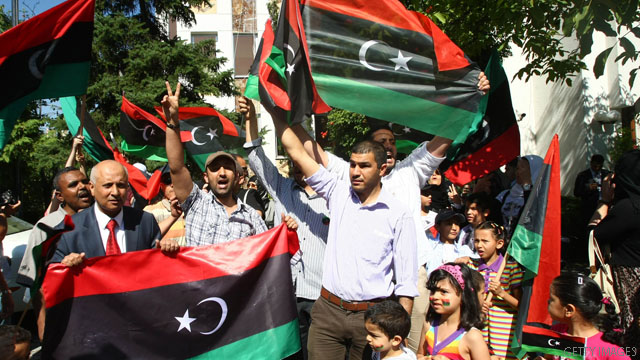
“... Libya has achieved the most far-reaching change of any country in the Arab Spring. But it is also the country that carries the highest risk of losing those gains and descending into violent instability.” (Noueihed - Warren, 166) Technology and the youth have had a positive context to them up until now when we go into detail on Libya and how it took Muammar Gaddafi out of power in the violent manner that it did. Thousands upon thousands of people had died over many years in Libya, tragedy after tragedy seemed to happen and Muammar Gaddafi was largely at fault, his isolationist ideals had been suffocating the youths of Libya for far too long. It all come back to haunt him far quicker than anyone could have predicted but then again revolution by its nature is a hard thing to predict.
 Libya had followed suit with Tunisia and Egypt in their revolutions and an organization titled “National Conference for the Libyan Opposition” directed a call out on social media. They wanted their fellow Libyans to take part in an event they termed as the “Day of Rage”, their intent was to group up as a whole community and voice their criticisms on politicians and the current economic conditions. It however turned into something much more violent, and had a much darker theme that lingered with it until its inevitable end.
“The first image was posted online around lunchtime on 20 October. Taken at knee-height, it showed the top half of a man with bedraggled hair, drenched in blood, being dragged along by his shoulder. More photos followed, and then the inevitable videos, recorded shakily on mobile phones, were uploaded. Some showed Gaddafi mumbling incoherently while being slapped or beaten. Others showed the concrete sewer in which he and his bodyguards had sheltered after their convoy, trying to flee the besieged and ruined city of Sirte, had been hit by an air strike, Later, more graphic footage appeared to show one rebel fighter sodomizing Gaddafi with a stick. ‘What did I do to you?’ were among his last words, according to eye-witnesses. It was reportedly an eighteen-year-old from Misrata who fired the fatal shot into the side of Gaddafi’s head.” (Noueihed - Warren, 187) While Muammar Gaddafi may have done terrible things, this was not the way things should have been done. The protests had started out the same as Tunisia and Egypt but then somewhere along the lines it misshapen itself and reformed into something else. If they were following in the footsteps of Tunisia and Egypt then they should have proceeded with peaceful, non-violent protest movements. This kind of rage just illustrates that Libya isn’t truly ready to do anything but become an outraged mob of youths. This is not what should have happened and it proves little in the respect that Libya as a whole is ready to take itself onto something better than its corrupt leader had before. Neither side of the conflict is right in this situation, this shows that youths with technology can have great volumes of negative conclusions as well as positive conclusions. The two go hand in hand and are apart of the same coin.

We have seen some great outcomes from these Arab uprisings. Technology has undeniably played a key role in every one of the revolutions. The current technology however hadn't stopped there; technology has been ever evolving. It helped to shape where the revolutions took Egypt, Tunisia, and Libya and in turn technology helped to direct where and what the conclusions of these revolutions would be. However technology hadn't done this all on its own, it had all of its help from the savvy youths that knew how to properly utilize social networks, internet and wireless cellphones; hand in hand these two players orchestrated the revolutions. If there wasn't a huge population of outraged young Arabs much of this wouldn't have happened. A lot of positives came out of the relationships between the youth and the technology they utilized but at the same time a lot of negatives emerged as well. Libya was a central role to those types of outcomes and it needs to be understood as to why the events that followed happened the way they did. Tunisia, Egypt and Libya collectively have made progress thus far but have a long way to go. They have done what most thought to be impossible and out of reach; and yet here they are. Doing the impossible.
Works Cited
1. Hellyer, H.A., and The Opinions Expressed in This Commentary Are Solely Those of H.A. Hellyer. "Egypt's Revolution on the Margins." CNN. Cable News Network, 25 Jan. 2014. Web. 13 Apr. 2014.
2. Sloan, Alastair. "Libya's Revolution "will Not Stop until We Have Freedom" - Index on Censorship | Index on Censorship." Libya's Revolution "will Not Stop until We Have Freedom" - Index on Censorship | Index on Censorship. Xindex, 27 Jan. 2014. Web. 13 Apr. 2014.
3. Castillo, Ana A. "The Arab Youth after the Revolution: Civically Engaged, Yet Not Empowered | United Explanations." United Explanations. United Explanation, 02 June 2014. Web. 13 Apr. 2014.
4. Gall, Carlotta. "Tunisian B-Boys’ Biggest Battle: Keeping Youths From Extremism." The New York Times. The New York Times, 16 Feb. 2014. Web. 13 Apr. 2014.
5. James Gelvin, The Arab Uprisings: What Everyone Needs To Know. (New York: Oxford, 2012).
6. Wael Ghonim. Revolution 2.0: The Power of the People is Greater than the People in Power. (Boston: Houghton Mifflin, 2012).
7. Lin Noueihed and Alex Warren. The Battle for The Arab Spring: Revolution, Counter-Revolution, and the Making of a New Era. (New Haven: Yale, 2012).